
The brain is never too old to change
Names that don’t arrive when you want them. A conversation in a busy room that’s harder to follow than it used to be. These changes are common with age. The good news is that most of them can be reverted with training.
What people notice first
Rarely one dramatic moment. Usually a series of small ones.
✓ The name is there, and it arrives ten seconds too late
✓ Following a conversation with three people in it takes real effort
✓ New things: a phone, a form, an appliance, take longer to learn
✓ Walking into a room and losing the reason
✓ Reading a page over and over to hold what’s on it
✓ Doing two things at once no longer feels free
Most of this is ordinary age-related change, not illness. That’s precisely why training is worth doing.
More is happeing underneath. We look for the cause.
The common assumption is that memory is failing. Far more often, what’s changed is processing speed and working memory, that is how fast information comes in, and how much can be held while it’s used.
The knowledge is still there. What’s slowed is the retrieval. A name you’d have produced instantly at forty surfaces a few seconds later at seventy, not because it’s gone, but because the route to it takes longer.
That distinction matters, because speed and working memory are among the most trainable cognitive skills there are. Researchers call the buffer built by staying mentally active cognitive reserve, and it is built the way physical fitness is built: with effort, repeated, over time.
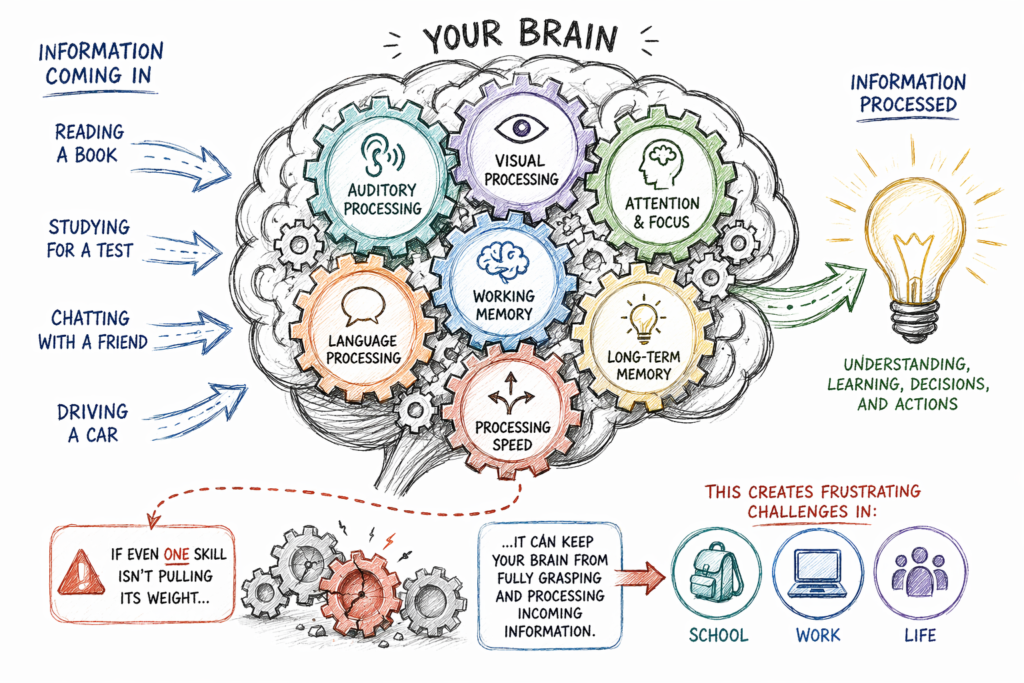
Four core skills related to aging
Processing speed
How quickly information is taken in and acted on. When it’s slow, everything else has to wait in line behind it.
Working memory
Holding information in mind while you use it. The skill behind following instructions, mental arithmetic, and remembering the start of the sentence by the time you reach the end.
Attention
Filtering. Staying with one voice in a restaurant, reading with the television on, not losing your place when interrupted.
Logic and Reasoning
Working things out. New technology, unfamiliar forms, decisions with several moving parts.
This is not a crossword, and it's not an app
Puzzles, apps and crosswords
- You get better at the puzzle
- No measurement of what actually improved
- Difficulty doesn’t track your specific weak skills
- Easy to give up and not challenge oneself
One-to-one cognitive training
- Assessment first, you find out which skills are actually weak
- A trainer pushes the difficulty to the edge of what you can do, every session
- Targets the two or three skills with the most effect on daily life
- Measured before and after, so improvement is a number rather than a feeling
The brain adapts to demand. A puzzle you’re good at makes no demand. The trainer’s job is to keep you working just past comfortable.
How we start
Free consultation
We listen to what you’ve noticed, what you’d like to be easier. We explain the program in detail, and tell you whether we’re the right fit.
The Gibson Test
A world renown assesment of cognitive skills. You get a written report showing where the strengths and weaknesses are.
A need based plan
Focused on the skills that will change your daily life most, not a general programme.
One-to-one training
One trainer, one learner. Demanding, sociable, and adjusted as you go.
How to raise it without making it a confrontation
Most enquiries for this programme come from a son or daughter. If that’s you: the conversation goes better when it’s framed as maintenance rather than concern, the same way you’d talk about physical exercise. Nobody wants to be told their memory is going.
You’re welcome to come to the consultation together. We go through the program and discuss in detail your worries and see if the programm is a good fit for your case.
Common Questions
No. The capacity of the adult brain to change with training, continues throughout life. It’s slower than at twelve, which is why intensity and consistency matter more, not less.
No, and be sceptical of anyone who says otherwise. We train cognitive skills and we measure the change. Staying mentally active is associated with greater cognitive reserve, but that is not the same as prevention, and we won’t present it as such.
Apps make you better at the app. There’s no assessment, no one adjusting the difficulty to you, and no measurement of anything outside the game. Our training is one-to-one with a trainer who pushes the level every session and measures before and after.
The Gibson Test is a cognitive skills assessment, not a medical diagnosis.
Typically three times a week over several months. Cognitive change comes from intensity and repetition, once a fortnight won’t do much, and we’d rather tell you that now. For seniors we also offer to come to your place and do the training there, provided that the place meets the minmal standards.
The training can be held in both language, based on your preference.
Find out where you actually stand
A free consultation, no obligation. We’ll tell you what we’d assess, what a plan would look like, and whether we think the program is the right one for you.