
When the effort is there, but the results are missing
Studying longer only works if the skills underneath are keeping up. We measure the cognitive skills that learning actually runs on attention, working memory, processing speed, and train the ones holding everything else back.

Where does the time go?
Find the card that souns like you.
School
- Rereads the same paragraph to make it stick
- Knows it at home, blanks in the test
- Homework takes twice as long as it should
- Careless mistakes on work they clearly understand
University
- Lectures move faster than the notes can
- Weeks of revision, and the recall still isn’t there
- Reading load feels impossible to stay on top of
- Concentration collapses after forty minutes
Work
- Rereading the same email over and over
- Mental fog by mid-afternoon
- Losing the thread in longer meetings
- Detail work takes longer than it used to
These aren’t discipline problems, they typically have underlying cognitive skills that aren’t pulling their weight. The good news is that in most of the cases these are trainable.
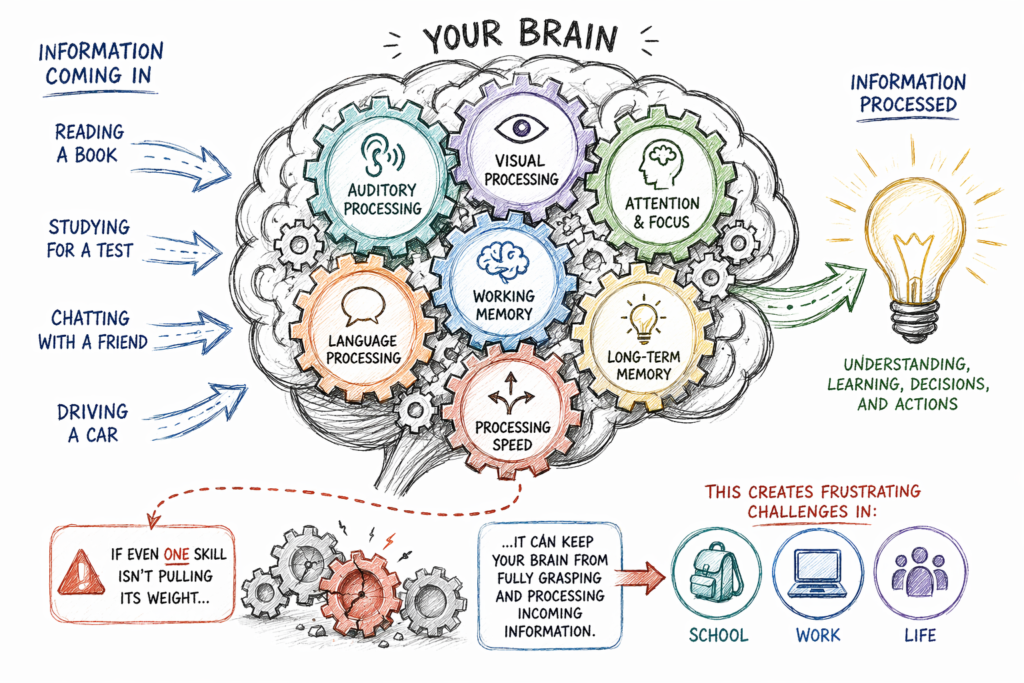
Learning is based on cognitive skills that can be measured.
Whether reading a chapter, following a lecture, or sitting an exam, every one of these runs on the same small set of cognitive skills working together: attention holds you on the task, processing speed determines how fast information gets in, working memory holds it while you use it, and long-term memory files it so it comes back later.
If one gear turns slower than the others, the whole machine slows to its speed. You can compensate with more hours, like most high-effort students do, but you’re paying for the same result with time your classmates spend elsewhere.
Training the weak skill removes the bottleneck. The hours you spent compensating are hours you get back.
When one of those skills is weaker than the rest, everything built on top of it gets harder. A child with slow auditory processing hears the instruction but has moved on before the second half lands. A child with weak working memory can decode every word on the line and hold none of the sentence.
Two children with the same diagnosis can have completely different cognitive profiles, which is exactly why the same support works for one and not the other.
The four skills that determine the learning and performace at work
Attention
Staying on one task while everything competes for it. The gateway skill, nothing downstream works well without it. Trainable, and not the same as willpower.
Working memory
Holding information while you manipulate it. Mental arithmetic, following a lecture, keeping the argument in mind while you read the counter-argument.
Long-term memory
Getting information to stick and retrieving it under pressure. The difference between “I knew this yesterday” and answering the question.
Processing speed
How quickly information is taken in and acted on. When it’s slow, comprehension is fine but everything takes longer than it should.
Your plan targets the skills your assessment identifies. Not a one size fits all program.
Why studying harder stops working
More study hours help when
- Material was genuinely missed
- The exam is close and it’s about coverage
- The subject is new and unfamiliar
Brain training helps when
- The hours go in and the result doesn’t change
- Every subject is affected, not one
- Notes are good, recall isn’t
- Concentration runs out long before the work does
Tutoring adds knowledge. Training raises the ceiling on how fast you can add it.
The same training, built around a working week
Cognitive skills don’t stop mattering when school ends, they just change job. Reading a contract, chairing a meeting, holding four threads at once on a busy afternoon: that’s attention, working memory and processing speed doing exactly what they did in a classroom..
“For a long time I thought I simply had to accept my difficulties with attention. After six months of intensive training I feel the difference. I concentrate better, process information faster, and I’m more confident through the day.”
How we start
Free consultation
We listen to your story, explain the program in detail, and tell you whether the programm is a right fit.
The Gibson Test
Measures core cognitive skills and produces a written profile. It names the things you’ve been guessing at for years.
A need based plan
Tareted at the skills that are holding you back, and sequenced to maximise the outcome.
One-to-one training
One trainer, one learner, several sessions a week. Intense enough to produce change, structured so it stays motivating.
Common questions
Tutoring teaches the subject. We train the skills you use to learn any subject. If tutoring has already been tried without lasting change, that’s usually a sign the bottleneck isn’t knowledge.
Yes, this is one of the clearest cases for training. High effort producing average results almost always means one skill is compensating for another.
Families usually notice behavioural changes, starting homework unprompted, less rereading, within halfway through the programm. Measurable cognitive gains usually take a full programme, typically 6 months.
You can, but it isn’t ideal. Training is demanding, and stacking it on top of Matura revision helps neither. Most students start well before exam periods, not right before one.
Yes, the programm is adopted to the age of the individual and his cognitive profile as measured by the Gibson Test. See the sections above.
Find out where the time is going
A free consultation, no obligation. We’ll tell you what we’d assess, what a plan would look like, and whether we think the program is the right one for you.