A diagnosis explains the struggle. We work on achieving your full potenital.
Whether there’s a formal diagnosis or just a growing suspicion, the same thing is usually true underneath: one or more brain skills aren’t working as hard as they should. We find out which ones, and we train them.
When focusing and following instructions seems impossible
Many kids with diagnosis show similar symptoms:
✓ Struggle to listen to and/or follow instructions? ✓Become easily distracted from the task at hand? ✓Have difficulty doing two things at once?
✓Avoid prolonged mental effort? ✓Have poorly organized thoughts and materials? ✓Often need things repeated?
Most often these challenges are linked to weaker cognitive skills, not intelligence.
WHY IT HAPPENS
The label describes the symptoms. We look for the cause.
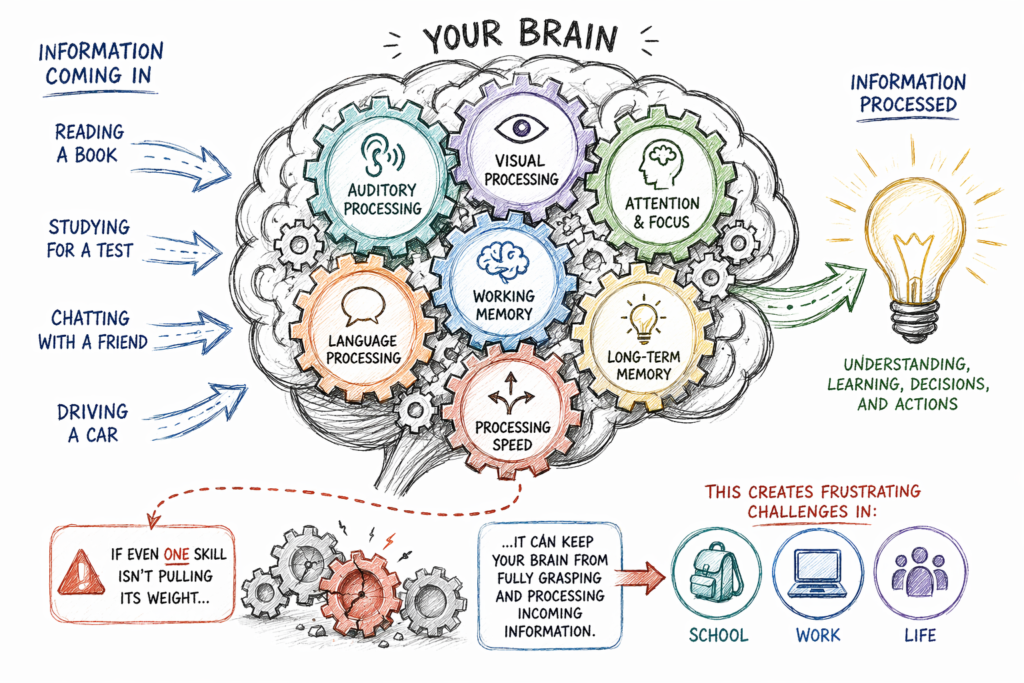
ADHD, dyslexia and autism are diagnosed by what a person does: how they read, how long they sustain attention, how they process what’s said to them, etc. But underneath those behaviours sit measurable cognitive skills: working memory, processing speed, auditory processing, attention, logic and reasoning.
When one of those skills is weaker than the rest, everything built on top of it gets harder. A child with slow auditory processing hears the instruction but has moved on before the second half lands. A child with weak working memory can decode every word on the line and hold none of the sentence.
Two children with the same diagnosis can have completely different cognitive profiles, which is exactly why the same support works for one and not the other.
WHAT WE TRAIN
Common skills behind learning differences
Attention
Satying with one task while the room, the phone and your own thoughts compete for it. Trainable, and not the same as willpower.
Working memory
Holding information in mind while you use it. The skill behind following instructions, mental arithmetic, and remembering the start of the sentence by the time you reach the end.
Auditory processing
Segmenting and sequencing the sounds inside words. The single most common weak skill in ADHD and Autism related traits.
Processing speed
How quickly information is taken in and acted on. When it’s slow, everything else has to wait in line behind it.
A tutor teaches the lesson. Training changes the equipment your child brings to the next lessons.
Why tutoring often doesn't move the needle here
Tutoring is the right choice when
A specific topic was missed through illness or a school change
The material is understood but needs review before an exam
The gap is knowledge, not capacity
Brain training is the right choice when
Tutoring has been tired and the gains didn’t hold
Every subject is affected, not one
Your child works longer than their classmates for worse results
There is a diagnosis, or an assessment is on the waiting list
The training plan is build for the individual, to target the skills their assesment identifies, not a standard package.
Before the programme, we had to do every homework together. Midway through the training, my child began completing assignment independently and on his own initiative. Today Maxi is much more confident at school and well on the way to catching up with his classmates.
- Maxi's mother, parent of an 8-year old with ADHD
How we start
Free consultation
We listen to your story, look at the report you have, explain the program in detail, and tell you honestly whether we’re the right fit.
The Gibson Test
A world renown assesment of cognitive skills. You get a written report showing where the strengths and weaknesses are.
A need based plan
Tareted at the skills that unlock the most, and sequenced so the foundations come first. The plan is updated dynamically based on the progress as we go.
One-to-one training
One trainer, one learner, severlas sessions a week over months. The key here is to keep the brain engaged and motivated, with the plan being adjusted along the way for maximum effect.
No. The Gibson Test measures cognitive skills directly, so it works the same whether or not a diagnosis exists. Many families come to us while they’re on a waiting list for an assessment.
No, and we won’t tell you otherwise. We are not a medical service and we don’t diagnose or treat conditions. We train the underlying cognitive skills, which for many people makes daily tasks measurably easier. It works alongside whatever medical or therapeutic support you already have.
Yes. Adults with ADHD, dyslexia, learning difficulties or brain injury train the same skills, usually with fewer sessions per week and a schedule built around work.
Find out which skills are holding your child back
A free consultation, no obligation. We’ll tell you what we’d assess, what a plan would look like, and whether we think the program is the right one for you.