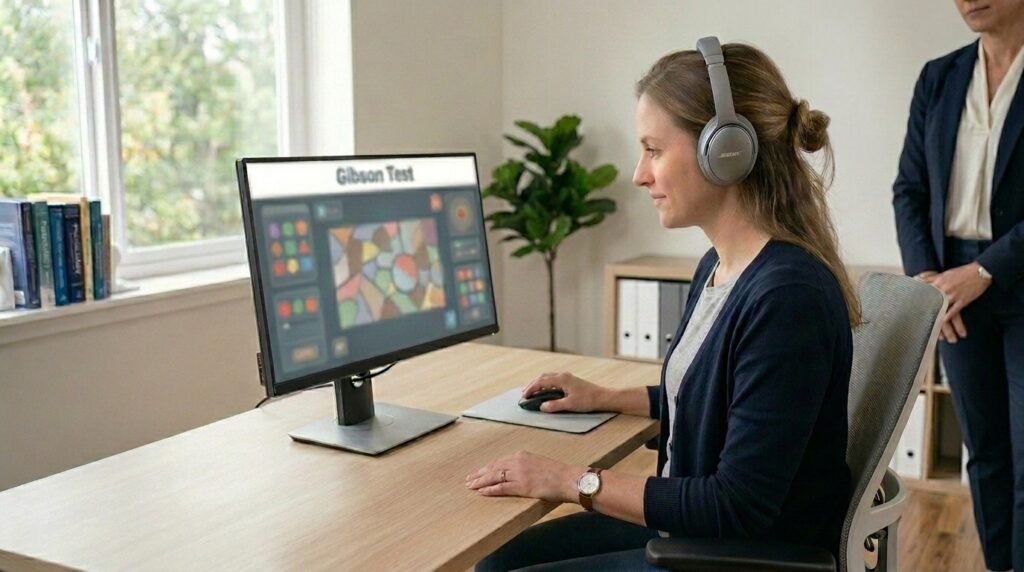
THE GIBSON TEST

Find out your strenghts and weaknesses

Struggling with reading, focus or memory is a symptom not a cause. The Gibson Test measures the seven core cognitive skills underneath and shows you precisely which ones are strong and which are holding you back.

brainrx logo small
in minutes
core skills assessed
for all ages
99 +
years of research
+
kid doing homework with mother 202608052251
A complete picture, not a single score

The Gibson Test measures each cognitive skill independently, so you see the full cognitive profile, with strengths and weaknesses that need to be addressed.

kid doing homework with mother 202608052251
Standardised and repeatable

Every activity is administered the same way and scored aginst age matched norms. That makes the result reliable enough to act on, and to compare against a re-test later.

kid doing homework with mother 202608052251
A report and a real conversation

You get a in-depth written report and a consultation that explains what it means in plain language, and what to do next.

Before the programme, we had to do every homework together. Midway through the training, my child began completing assignment independently and on his own initiative. Today Maxi is much more confident at school and well on the way to catching up with his classmates.
- Maxi's mother, parent of an 8-year old with ADHD
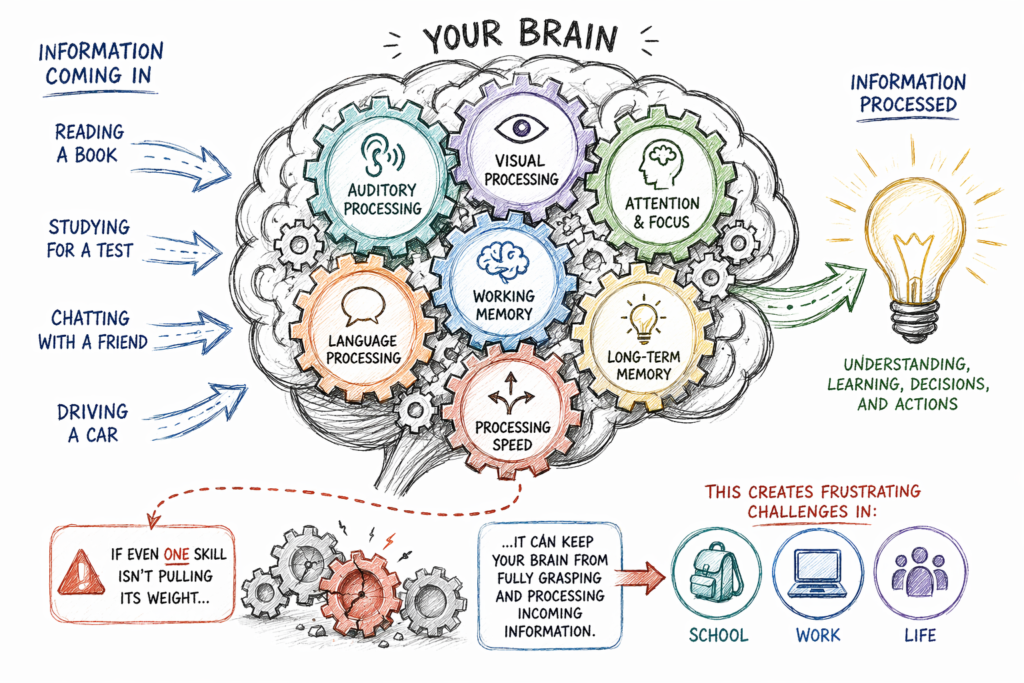
analogy info processing eng
WHY IT MATTERS

Symptoms are visible. Causes are not.

A brain that reads slowly might have weak auditory processing, weak working memory, or slow processing speed. Three different causes, three different training plans — and from the outside they look identical.

School reports, work performance describe the outcome. The Gibson Test looks underneath it. Developed in the United States by Dr Ken Gibson and refined over decades of research, it isolates each cognitive skill so the cause becomes visible and treatable.

It works in both directions. The same profile that reveals a weakness also reveals genuine strength — useful if you suspect high ability rather than difficculty.

quotes.svg

80 percent of learning disabilities are caused by a weakness in some cognitive ability.

dr ken gibson.jpg
Dr. Ken Gibson
Founder of LearningRx
WHAT TEST MEASURES

Core Cognitive Areas

Seven core cognitive areas behind every day performance.

Attention

Holding focus on one task, and  resisting distraction.

Processing speed

How quickly the brain takes in and makes sense of new information.

Long term memory

Storing information reliably and retrieving it later.

Logic and reasoning

Working out what to do when the answer isn’t given, analyzing, infering, and solving new problems.

Auditory information processing

Analyzing, blending and segmenting sounds.

Visual information processing

Taking in images, diagrams and spatial relationships, and forming mental pictures from what you need.

Working memory

Holding information in mind while following multi-step instructions, mental arithmetic.

Ovearall score

The seven commbine into one measure, like an IQ score, but far more useful, because it shows which underlaying skills produced it.

READIN THE REPORT
Three ways your scores are expressed

We explain all of this in person, but here is wat you’ll be looking at.

Age equivalent

How the score compares to the average for different ages. A result of 12.1 means that skill is performing at the level typical of a twelve-year-old. 

Standard scores

How far above or below average a skill sits on a common scale where 100 is average — the same scale used for IQ.

Age Percentiles

What share of same-age peers the score is above. The 84th percentile means outperforming 84 out of 100 peers of the same age.

After a training programme we re-test using the same instrument. Because the baseline is standardised, the comparison shows exactly where the gains happened and how large they were.

Questions?

Book a free initial consultation

Frequently asked questions

A standardised cognitive assessment developed in the United States by Dr Ken Gibson, founder of LearningRx. It measures the seven core cognitive skills the brain uses to take in, process and apply information. It’s the diagnostic step that a BrainRx training plan is built on — and it’s used in centres in dozens of countries.

It includes an overall measure comparable to IQ, but that’s a by-product rather than the point. An IQ score tells you where someone sits; the Gibson Test tells you why — which specific skills produced that number and which of them can be trained.

School assessments measure what has been learned — reading level, maths attainment, subject knowledge. The Gibson Test measures the underlying capacity to learn. Two children with identical grades can have completely different cognitive profiles, and they need different support.

Children from primary school age, teenagers, adults and seniors. There’s no upper age limit. The activities and the norms are matched to the test-taker’s age group, so the result is always a comparison against relevant peers.

Around 60 minutes in a single sitting, plus a separate results consultation afterwards. There’s nothing to study and nothing to bring. Being well-rested matters more than anything else. It’s an assessment of how the brain performs, so we want it performing normally.

Reading difficulty and dyslexia, attention difficulties and ADHD, slow homework and poor study stamina, weak memory, difficulty following instructions, and the cognitive effects of concussion or age-related decline. It also identifies unusually high ability. The test does not produce a clinical diagnosis — it produces a cognitive profile, which is a different and complementary thing.

No. Plenty of families take the test purely to understand what they’re dealing with, and that’s a legitimate outcome. If we don’t think brain training is the right answer for your situation, we’ll tell you that directly.

Yes. The assessment and the results consultation are available in German, English and 20 other languages.

The assessment is delivered in person at our Vienna centre so that conditions are consistent and the timings are accurate. The free initial consultation can be by phone or video.